
Mid century kitchen design is specific without being complicated. The style has a clear set of elements that work together, and removing or replacing any one of them tends to pull the room in a different direction. Understanding what those elements are, and which changes have the most impact, makes the difference between a kitchen that looks MCM and one that only gestures at it.
Flat-Panel Cabinets: The First Mid-Century Modern Design Element
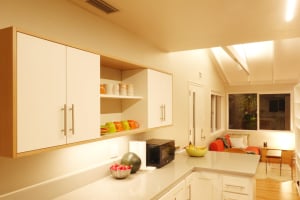
The flat slab door is the first and most important design element in any mid century modern kitchen. No raised panel, no recessed center, no visible frame. One flat surface that reads as a single material from edge to edge. This is not a simplified version of something more elaborate, it is the version that belongs in a mid-century kitchen.
The door profile carries the room because it appears across the majority of the visible surface area. Cabinet doors and drawer fronts account for most of what the eye registers in a standard kitchen. Get the profile wrong and no other design element fixes it.
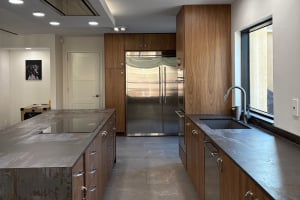
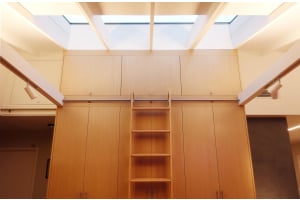
What this looks like well executed is visible in the light oak slab cabinet doors in a real project at 27eStore: flat profile, consistent grain direction, no detail on the face. The cabinetry reads as part of the architecture rather than furniture added to a room.
Wood Cabinets and Warm Mid-Century Modern Color
Oak, teak, and walnut are the three wood species most associated with mid century modern furniture and cabinetry. In a contemporary mid-century kitchen, light oak and natural oak tones work particularly well because they sit at the warmer end of the neutral range without going golden or orange.
Wood cabinets bring a quality to the mid-century kitchen that painted cabinetry alone cannot provide: the room feels inhabited rather than sterile. Even when the kitchen is predominantly white, a wood-toned element grounds it. The wood is not decoration, it is temperature. It changes how the room feels to be in.
Color in a mid century kitchen is more about the accent than the base. Orange, turquoise, and terracotta have strong historical connections to the MCM period and work well as controlled accent colors in ceramics, textiles, or a single painted element. The base palette stays neutral so the accent color has somewhere to land.
Statement Lighting: A Mid-Century Modern Kitchen Essential
Statement lighting is often the most visibly decorative design element in an otherwise restrained mid century kitchen. Pendant lights with organic shapes or a geometric structure work over an island or a dining table because they introduce a focal point without adding clutter. The classic retro MCM light fixture, the Sputnik chandelier with its radiating arms, is the most recognizable form from the period.
The principle is that one strong lighting choice can carry the decorative weight of the entire kitchen interior. Once that fixture is in place, most other decorative decisions become easier because they only need to complement rather than compete.
Open Shelving Used with Restraint
Open shelving in a mid-century kitchen is not a full wall of exposed storage. It is one or two sections of open display among predominantly closed flat-panel cabinets. The objects on those shelves become part of the kitchen design, which means they need to be selected with the same care as the cabinetry itself.
What belongs on open shelving in a mid century kitchen: ceramics with simple forms and bold glazes, a set of matching mugs or glasses, a plant in a ceramic pot. Organic shapes read well in this context. The display should be spare enough that each object registers individually rather than disappearing into a mass of things.
A backsplash stainless steel section behind a cooking range, or a stainless tile in a simple format, connects to the MCM interest in industrial materials used honestly. The style was always comfortable mixing natural wood with what were then new materials, and stainless steel sits within that tradition.
Large Windows and the Architecture of Mid-Century Modern Kitchen Design
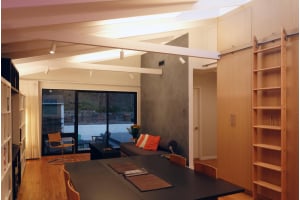
The original MCM architecture prioritized the relationship between the interior and the outdoors. Large windows, sliding glass panels, and open sightlines to a garden or terrace were part of the design from the beginning. In a kitchen renovation, this means maximizing natural light wherever the architecture allows and keeping the area near windows free of tall upper cabinets.
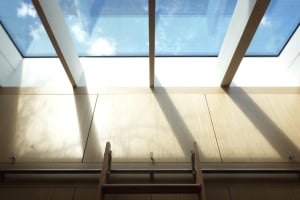
Skylights appear in mid century modern homes precisely because they bring daylight into interior spaces that cannot get it from a wall, and they do so in a way that feels like a considered architectural decision rather than an afterthought. In a mid-century kitchen renovation where a skylight is already present, designing around it is a priority. Where one can be added, it is often the highest-impact change the architecture allows.
Frequently Asked Questions
What are 5 key elements of MCM decor?
Flat-front cabinetry in wood veneer or a clean matte finish, warm natural wood tones, statement lighting with a geometric or organic form, a restrained neutral color palette with one or two bold accent colors in accessories and textiles, and a strong connection between interior and exterior through large windows or open plan layout.
What are the key elements of mid century modern design?
Clean lines, natural materials including oak and teak, functional design that avoids ornament for its own sake, an openness to industrial and manufactured materials alongside natural ones, and a belief that good design should be livable rather than precious. The retro MCM period was defined by optimism about what well-made objects could contribute to everyday life.
How do I make my kitchen look mid century modern?
Start with the cabinet doors. A flat slab profile replaces more visual noise than any other single change. Follow with simple hardware, a warm wood tone or clean matte white finish, and one strong lighting choice. The most compelling mid century kitchen makeovers tend to start with one element and let the rest follow.
For homes that are not purely mid century modern in their architecture or existing furniture, working these elements into a more contemporary space requires a slightly different approach, one that blends styles rather than replacing one with another entirely.